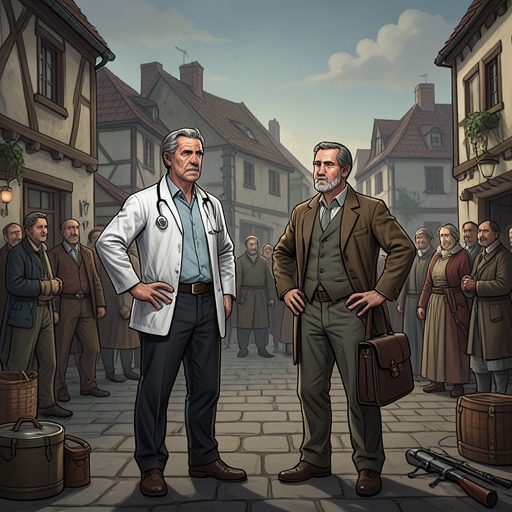
Someone breaks into Henry’s surgery and steals chloroform
The Chemistry of DeathSomeone breaks into Henry Maitland’s surgery and steals chloroform in an episode that makes an apparently secure medical workplace part of the danger surrounding Manham. David Hunter surprises the intruder, who escapes after knocking him aside; the locked drug cabinet remains untouched, but a bottle from Henry’s display of medicinal relics is gone. In the aftermath, Henry’s uncertain recollections suggest that access may have been gained before, while the intruder’s identity and purpose remain unconfirmed.
Circumstances
David Hunter goes to Manham to collect his phone from the surgery, not expecting an emergency. He still considers himself the village doctor, despite the reservations some villagers have about him, and does not want to lose contact with the community. On the way through the square, he sees men from Scarsdale’s vigilante patrol watching him under the streetlights. He then drives up to Henry Maitland’s house, where the dark windows seem consistent with Henry’s habit of going to bed early.
Rather than use the front entrance and risk waking Henry, David goes around to let himself into the surgery through the back. He notices that the kitchen door is open. The room appears undisturbed, and he hesitates to call the Police: he cannot tell whether anything is wrong, and worries that a needless alarm would further damage his standing in the village. Instead, he calls for Henry and proceeds towards the study, where a light is on and the door is ajar. The ordinary purpose of the visit has thus brought David into the building just as an intrusion is under way.
The intrusion
As David begins to push open the study door, it is suddenly pulled from his hand. A bulky figure bursts out, knocks him aside, and escapes through the kitchen. David catches at coarse, greasy cloth but cannot stop the intruder. He starts after the fleeing figure, then remembers that Henry is inside and turns back. After briefly securing the garden door, he returns to the study; Henry comes into the hallway from his bedroom, startled by the commotion.
The break-in has not left the surgery wholly ransacked. David sees that the steel cabinet is still locked, so the intruder has not reached the drug store. But the glass case where Henry keeps medicinal relics has been opened, and its contents have been scattered. Henry is unsure what might be missing. David spots the absence of an old bottle that had long sat on the upper shelf: its green glass was ribbed in the outdated warning pattern used for poison. The missing container held chloroform. David had initially considered the possibility of a search for drugs, but doubts that an ordinary drug-seeker would have taken that particular bottle.
The interruption also exposes how close the encounter came to becoming worse. David realizes that his shirt has been slashed open during the struggle. The intruder has escaped, and the evidence of the attack is not a captured suspect but a disturbed display, a missing bottle, and damage to David’s clothing. Nothing in the scene identifies who entered or establishes what they intended to do with the chloroform.
Earlier access and uncertainty
The break-in takes on a different significance when Henry later admits that this may not have been the first time someone had entered. He recalls a couple of recent occasions when he found a door open, though he had generally reminded himself to lock up. He also says that on a couple of occasions the cabinet seemed rearranged. He had not been certain that anything was missing and had wondered whether his memory was playing tricks on him; embarrassed, he had hoped that simply making more effort would solve the problem.
These recollections do not prove that the same person was responsible for the earlier disturbances, or even that every apparent irregularity was an intrusion. Their uncertainty is precisely what makes them consequential: before David surprises the intruder, signs of possible access could be dismissed as Henry’s forgetfulness. The new theft gives those small lapses a more troubling possible explanation, without making them conclusive. David, who works with Henry, feels culpable for not noticing that something might be happening to him sooner.
Significance in the investigation
The contrast between the untouched steel drug cabinet and the opened relic case leaves the object taken, rather than a general theft of drugs, at the center of the episode. David asks why an intruder who had supposedly been inside before would not have taken the entire bottle. Mackenzie considers the possibility that the person wanted to avoid drawing attention to what had been taken; had the intruder not been interrupted, the theft might not have been discovered that night. This remains an explanation, not a confirmed motive.
The episode therefore supplies the investigation with both a concrete clue and a limit on what can be inferred from it. Chloroform has been removed from a medical setting, and an intruder has shown a willingness to confront David to escape. Henry’s memories raise the possibility of previous access, but cannot settle its timing or purpose. The break-in transforms the surgery from a familiar workplace into a vulnerable point in the investigation, while leaving the central questions—the intruder’s identity and intended use of the chloroform—unanswered.